
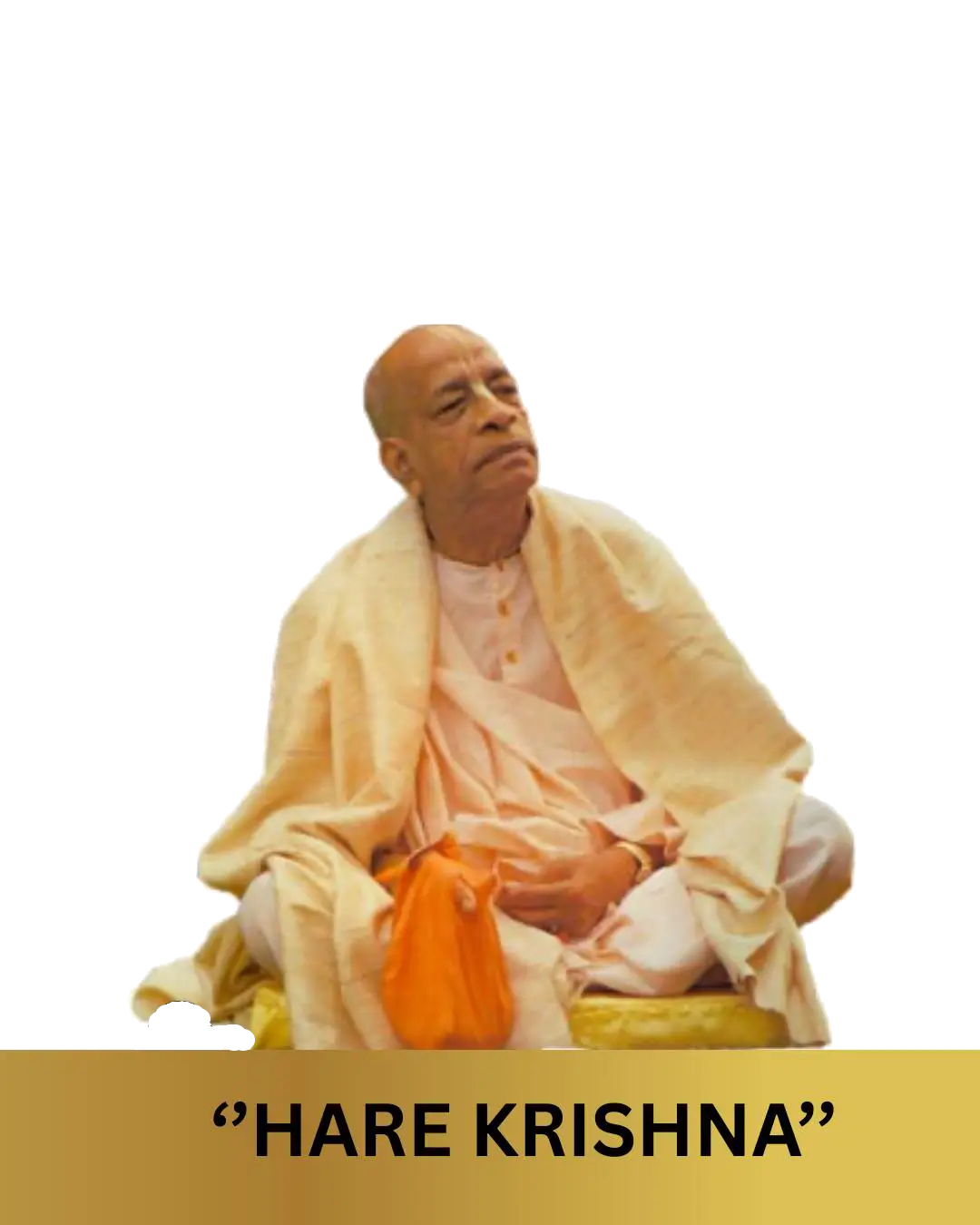
His Divine Grace A.C. Bhaktivedanta Swami Prabhupada (1896-1977) is widely regarded as the foremost Vedic scholar, translator, and teacher of the modern era. He is especially respected as the world’s most prominent contemporary authority on bhakti-yoga, devotional service to the Supreme Person, Sri Krishna, as taught by the ancient Vedic writings of India. He is also the founder-acharya of the International Society for Krishna Consciousness.
Srila Prabhupada, as he is known to his followers, translated and commented over eighty volumes of the Vedas’ most important sacred bhakti texts, including the Bhagavad-gita—a concise handbook for understanding the purpose and goal of human life—and the multi-volume Srimad-Bhagavatam—an epic biography of Krishna, Krishna’s avatars, and His many devotees throughout the history of the universe.
Srila Prabhupada’s own spiritual master, Srila Bhaktisiddhanta Sarasvati Thakur, was the leading proponent of Krishna consciousness in India during the early part of the twentieth century. He specifically taught the philosophy of Chaitanya Mahaprabhu, the divine avatar who revived Krishna-bhakti all over India in the 1500s. When Srila Bhaktisiddhanta first met the young man later known as Srila Prabhupada – in Calcutta in 1922 – he urged him to preach Chaitanya Mahaprabhu’s message of Krishna consciousness throughout the English-speaking world.
Sri Sri Radha Govinda are very special Deities who were personally worshiped by Srila Prabhupada in Jaipur, during the January 1972 Hare Krishna Festival. Thereafter, Srila Prabhupada directed that the Deities be sent to New York to be worshiped by his disciples there. Countless thousands of devotees have worshiped these sacred Deities for nearly a half-century.
In February 1972, ISKCON founder-ācārya Śrīla Prabhupāda brought some of his Western followers to Jaipur. Kauśalyā Devī Dāsī, one of his early American disciples who happened to be staying there, saw to her spiritual master’s accommodations: “I arranged for his stay on the City Palace grounds with the pujārī of the temple. None of the other devotees were allowed to stay on the grounds except Prabhupāda’s direct servants. The others had to stay in nearby rooms.”
Kauśalyā almost single-handedly arranged elaborate tent programs for Prabhupāda, with his presence generating excitement throughout Jaipur. “We organized and paid for the pandal programs with donations from several prominent citizens,” writes Kauśalyā. “As a result, we were invited to Gayatri Devi’s home – she was keenly interested in meeting Śrīla Prabhupāda.”
Rajamata Gayatri Devi (1919–2009) was the Queen of Jaipur at the time, and she was fully supportive of Prabhupāda’s stay at the City Palace. While there, Prabhupāda regularly lectured from a stage set up for him. Taken by his presence, purity, and the profundity of his words, Queen Gayatri Devi offered him a special gift: an elegant and stately residence on the grounds of the City Palace. Prabhupāda wanted to use the building for his mission in India, but for various reasons the transaction was never completed.
Around this same time, Śrīmatī Devī Dāsī, another of Prabhupāda’s early female disciples, arrived, and with Kauśalyā searched in Jaipur for deities on behalf of the New York temple, which was then in Brooklyn (439 Henry Street). Kauśalyā writes, “Srimati visited the finest murti walla [deity sculptor] and then she saw them – a beautiful black marble Krishna and white marble Radharani with conch shell eyes. When Srila Prabhupada and the devotees arrived, there was great jubilation. . . . He was very pleased with the deities and conducted the installation ceremony as part of the pandal program, and since the ceremony was to take place next to Govindaji, he named them Radha-Govinda.”
Sometimes it is said that Gayatri Devi donated these deities, but They actually appeared by the grace of Prabhupāda’s two disciples Kauśalyā and Śrīmatī.
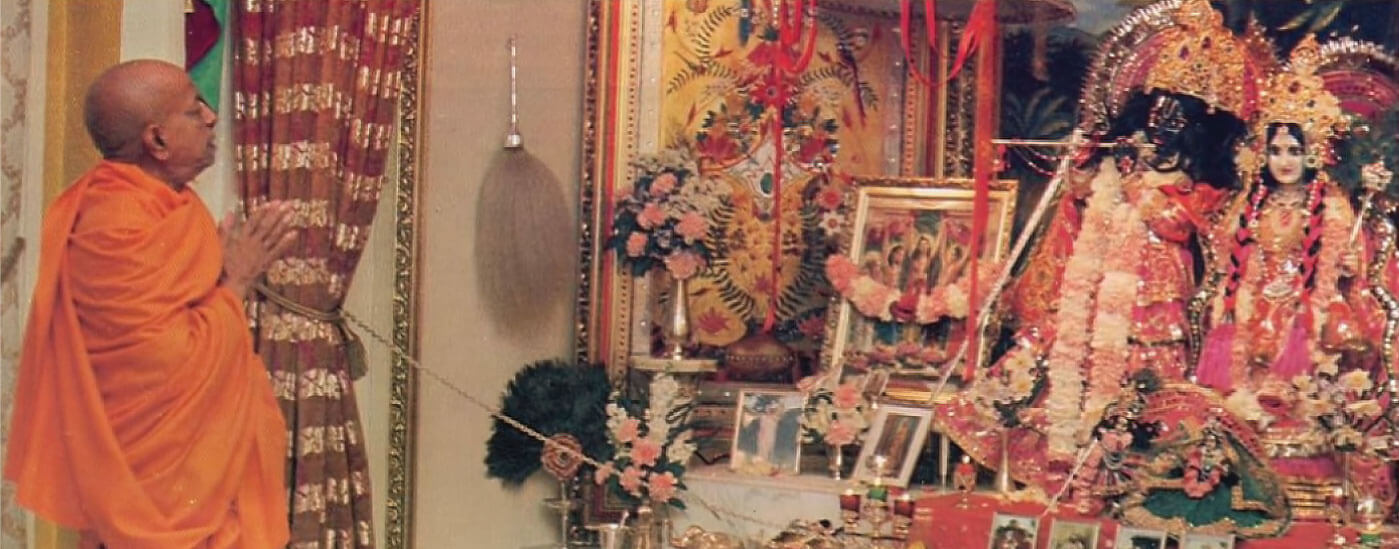
Śrī Śrī Rādhā-Govinda arrived in New York on March 1, 1972, and Their appearance was celebrated two days later on Gaura Pūrṇimā, the appearance day of Śrī Caitanya Mahāprabhu. The western devotees vowed to learn the science of worshiping Them properly, and they did.
Rādhā-Govinda’s international journey has been colorful and interesting: Govinda is installed by Vajranābha not long after Kṛṣṇa’s time on earth and rediscovered by the Vrindavan Gosvāmīs in the sixteenth century. Rādhā joins Govinda, and They are moved to Jaipur nearly two hundred years later. In new forms, they travel from Jaipur to Henry Street, Brooklyn, in 1972, then on to 340 West 55th Street, Manhattan, in 1975, and to 846 Seventh Avenue in Manhattan five years later. Finally, on November 1, 1982, They move to Their current temple at 305 Schermerhorn Street in Brooklyn, where They have given Their abundant mercy to committed devotees and temple visitors ever since.
(this article is gratefully excerpted from “O Govinda Within My Heart” Krsna’s Long Journey from Braj to Brooklyn” written by Satyaraja Dasa, Back To Godhead Magazine, Issue Sept/Oct 2018)